Historical Portrait
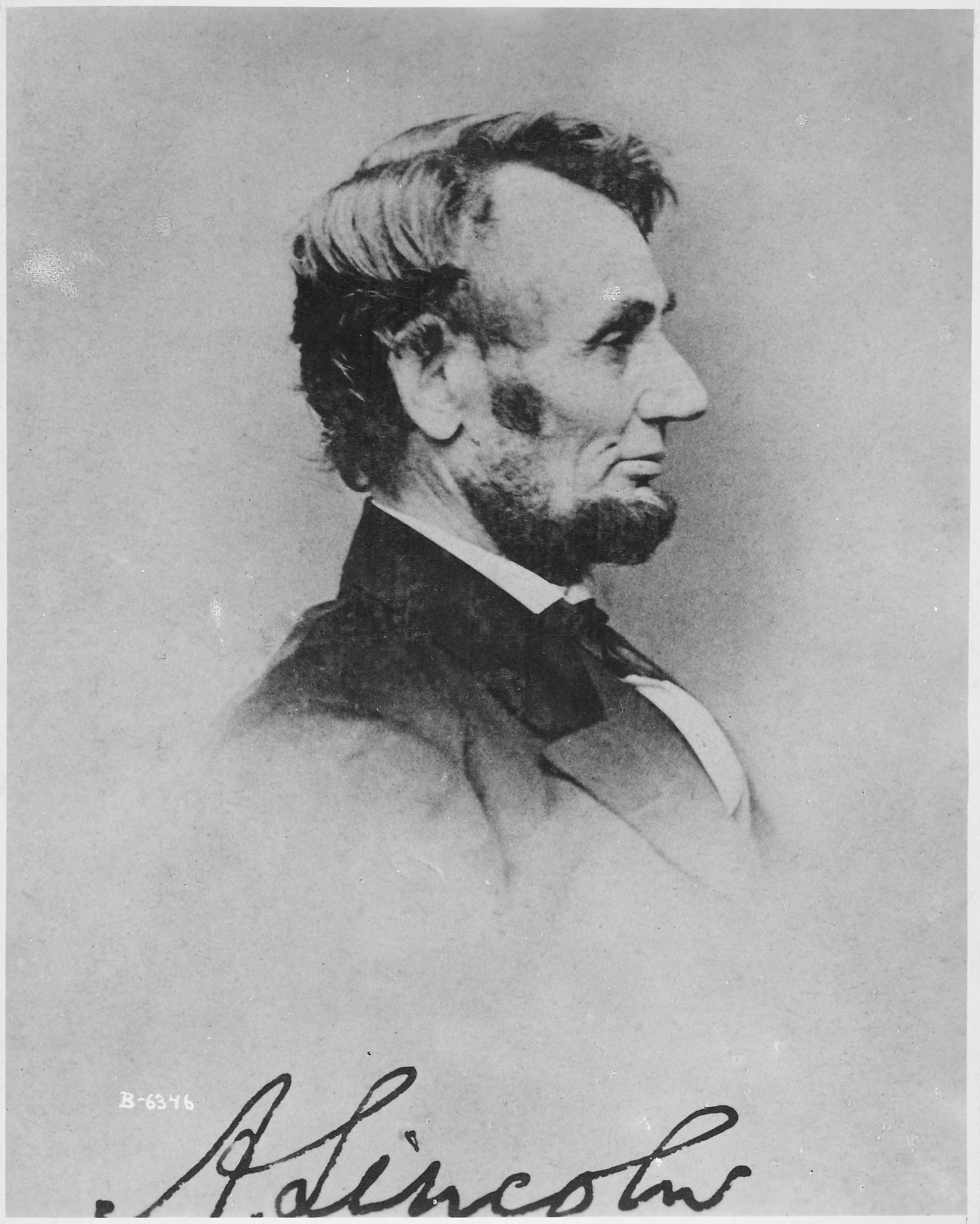
Photograph of President Abraham Lincoln.
Archive record
Abraham Lincoln (1809-65) was the 16th president of the United States. He was born on a farm in Kentucky and moved with his family to Indiana at age eight. At age 21, he moved to Illinois, where he held various jobs and began to study law. He had less than one year of formal education, but became a skilled writer by reading the King James Bible and other English classics. He practiced law in Illinois, served in the Illinois General Assembly, and was elected to the U.S. House of Representatives. In 1860, he was elected president of the United States on a platform opposing the expansion of slavery to the American West, a stance that precipitated the secession of the southern states from the Union. Refusing to accept secession, Lincoln waged war against the South to preserve the Union and ultimately to abolish slavery in the United States. He was killed by an assassin's bullet on April 14, 1865, shortly after the South's surrender. This photograph of Lincoln is by Mathew B. Brady (1823?-96), an early American photographer who opened a gallery in New York City in 1844. Although best known for his battlefield photographs in the Civil War, Brady first made his mark as a portrait photographer who captured many famous people on film.
About this photograph
Abraham Lincoln was the sixteenth president of the United States, born in Kentucky in 1809 and raised largely in Indiana. He moved to Illinois at twenty-one, studied law despite less than a year of formal education, and developed his writing through reading the King James Bible and English classics. He practiced law in Illinois, served in the state legislature, and won election to the U.S. House of Representatives before his 1860 presidential victory.
Lincoln's opposition to slavery's expansion into the western territories triggered the secession of southern states. Refusing to recognize secession, he led the Union through civil war to preserve the country and ultimately to abolish slavery. An assassin killed him on April 14, 1865, days after the South's surrender.
Mathew Brady photographed him in 1861. Brady opened a New York gallery in 1844 and became known for portraiture before his Civil War battlefield work.
Compiled from the catalogue record and reference notes on the formats and events involved. The archive record above is the primary source.
Rights & Attribution
Explore
More from the 1860s
![[Nurse Mary Ann Horner, wife of Dr. Robert Horner], 1861 (Library of Congress)](/api/img/nurse-mary-ann-horner-wife-of-dr-robert-horner-1861-C7yTmDHrJTCAjuhxr6xt.jpg)
![[First Lieutenant James N. Bell of Co. H, 5th Virginia Cavalry Regiment and Co. C, 13th Virginia Cavalry Regiment in uniform with his wife and daughter, Emmeline and Nannie Claudia Bell], 1861 (Library of Congress)](/api/img/first-lieutenant-james-n-bell-of-co-h-5th-virginia-cavalry-regiment-and-co-c-13t-KlZplH0iRMJr4W9iED98.jpg)
![[Unidentified Captain in Confederate uniform], 1861 (Library of Congress)](/api/img/unidentified-captain-in-confederate-uniform-1861-NezYtlTolMp75456Apc7.jpg)
![[Private Addison J. Bowman of Co. K, 57th Virginia Infantry Regiment in uniform with rifle, revolver, and D guard Bowie knife], 1861 (Library of Congress)](/api/img/private-addison-j-bowman-of-co-k-57th-virginia-infantry-regiment-in-uniform-with-QD7LFbIo77B4PFyII9y3.jpg)
![[Sergeant Abram G. Bradt of Co. D, 4th New York Heavy Artillery Battalion in uniform with sword], 1861 (Library of Congress)](/api/img/sergeant-abram-g-bradt-of-co-d-4th-new-york-heavy-artillery-battalion-in-uniform-amL6Nn94ZZYAz1Fyw2og.jpg)