Historical Portrait
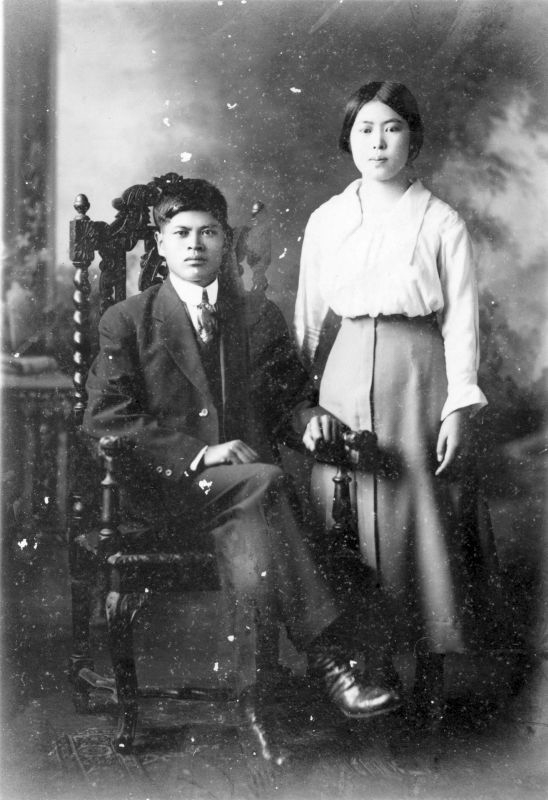
Masanojo with Masae Oku on her arrival as a picture bride
Archive record
1918 portrait of Japanese immigrants Masanojo and Masae Oku in San Francisco upon her arrival as a picture bride. Public-domain historical photograph.
About this photograph
The archive record identifies this 1918 portrait as showing Masanojo and Masae Oku, photographed in San Francisco when Masae arrived as a picture bride.
Picture brides were women who emigrated to marry men they knew only through exchanged photographs. The practice was common among Japanese immigrants in the early twentieth century, when immigration restrictions and long working hours made it difficult for men already in the United States to return home to marry.
The portrait would have been made soon after Masae's arrival, likely serving multiple purposes: to mark the couple's first meeting, to send back to relatives in Japan as proof of safe arrival, and to document the beginning of their married life together. Studio portraits from this period often bracketed the immigration journey, made at home to leave with family or made after arrival and posted back as evidence of having reached America and started a new life.
The photograph is held by the Tulare County Library. Tulare County sits in California's San Joaquin Valley, a farming region that drew many immigrant families to work in its irrigated agriculture during the late nineteenth and early twentieth centuries.
Compiled from the catalogue record and reference notes on the formats and events involved. The archive record above is the primary source.
Rights & Attribution
Explore
More from the 1910s